
Buying a house is one of those occasions where the list of things to check seems endless. Is the roof sound? Is it damp? How old is the boiler? What is that strange noise coming from the pipes?
And then there is the chimney.
It is easy to look at a chimney during a viewing, see a stack that appears to be standing perfectly well and assume there is nothing to worry about. Even a professional property survey may only tell you so much. The problem is that some of the most important parts of a chimney are hidden from view.
A crack inside the flue, damaged liner, obstruction or other defect can sit unnoticed for years. You may only discover it once you move in, light the first fire and realise that your lovely new fireplace is going to need several hundred, or potentially more than £1,000, spent on it before you can safely use it.
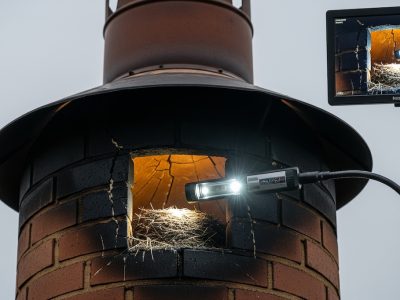
That is why a dedicated cctv chimney inspection can be a very sensible step before exchanging contracts.
Why doesn’t a standard house survey find everything?
First, it is worth saying that this is not about criticising surveyors. A house survey and a specialist chimney inspection serve different purposes.
An RICS Home Survey is designed to give a professional assessment of the property’s condition, but it is primarily a visual inspection. RICS itself explains that further investigation may be needed where parts of a property are hidden, inaccessible or require specialist knowledge. Chimneys are a classic example.
A surveyor may be able to inspect the chimney stack from outside, look at visible brickwork, check for obvious deterioration and assess what can reasonably be seen from accessible areas. But they cannot simply see through several metres of masonry and inspect the inside of a flue.
In fact, sample RICS survey reports make the limitation very clear: concealed or inaccessible areas cannot be fully assessed, and additional defects may only become apparent when further investigation or exposure work is carried out.
So when a survey says something along the lines of “the chimney should be inspected by a specialist”, don’t treat that as a throwaway recommendation.
It is effectively telling you: we couldn’t see everything here, so someone who can needs to take a closer look. And before you exchange contracts is exactly when you want to do it.
The problem could be hiding inside the chimney

From the outside, a chimney can look surprisingly healthy while the inside tells a completely different story.
Years of heat, moisture, condensation and general use can take their toll on the flue. Older properties can be particularly interesting because their chimneys may have been altered, relined, blocked off, reopened or adapted for different appliances over the decades.
A visual inspection from the room below cannot necessarily tell you what is happening inside.
A CCTV inspection, on the other hand, gives a specialist a much clearer view of the flue itself. Webb & Son’s CCTV service uses high-resolution equipment to inspect the inside of the chimney and identify issues that may not be visible during a standard sweep.
That can help identify things such as:
- Cracks within the flue
- Damage to the chimney liner
- Blockages or obstructions
- Structural deterioration
- Debris inside the flue
- Areas requiring further investigation or repair
It is a bit like buying a car and checking the paintwork without ever looking under the bonnet. Everything might look lovely from the outside. That doesn’t necessarily mean everything underneath is in good condition.
What can a chimney CCTV inspection actually show?

This is where the technology becomes particularly useful for a prospective buyer.
Rather than relying entirely on assumptions about the condition of the flue, a camera can be fed through the chimney to provide a visual inspection of the internal surfaces.
Webb & Son describes its CCTV inspections as providing a high-resolution view of the inside of the flue, helping to pinpoint cracks, blockages and structural damage within the chimney liner. The inspection also provides visual evidence that can help determine what, if anything, needs to be done next. That distinction matters.
Imagine your survey says there is an old fireplace and chimney breast in the property, but the flue has not been used for years. You might reasonably assume that means it is fine. But unused does not mean perfectly preserved.
There could still be damage or an obstruction inside. Conversely, a CCTV inspection might show that the flue is in perfectly reasonable condition.
Both outcomes are useful.
The first gives you an opportunity to negotiate or reconsider. The second gives you reassurance before you commit to the purchase.
Why old houses deserve particular attention

There is something rather appealing about an old fireplace.
Original brickwork. A timber mantel. A deep hearth. Perhaps even the remains of a Victorian range hidden somewhere underneath a later renovation. But with character comes history, and that history can be complicated.
Chimneys in older properties may have been used with open fires, coal fires, gas appliances, wood burners and other heating systems over their lifetime. Fireplaces may have been removed or altered, while chimney breasts can have been partially or completely closed off.
A chimney that looks straightforward from the living room may therefore have a much more complicated story above it.
This is particularly important if you are buying an older property with the intention of installing a wood-burning or multi-fuel stove. You need to know what you are working with rather than discovering problems halfway through the installation.
A CCTV inspection can form part of that investigation. It is not a substitute for every other relevant inspection or professional assessment, but it can provide valuable information about the condition of the flue itself.
The £1,000 mistake that can happen after moving in
Picture the scenario. You’ve found the house you love. The offer is accepted. The survey comes back with a few fairly standard jobs. You are already thinking about paint colours, sofas and where the Christmas tree will go.
- The chimney gets overlooked.
- You exchange contracts, complete the purchase and finally get the keys.
- Then you decide to get the fireplace checked before using it.
- The inspection reveals damage inside the flue.
Suddenly, the fireplace you thought would be ready for cosy winter evenings needs remedial work, a liner or further investigation before it can safely be used.
The final bill can quickly become much more irritating than the cost of investigating the chimney before you bought the property.
And £1,000 is a useful figure to keep in mind here — not because every chimney problem costs £1,000, but because relatively modest-looking defects can become expensive once specialist labour, materials, access equipment and associated repairs are involved.
More broadly, the cost of overlooked defects is not insignificant for new homeowners. Research published by Aviva in 2026 found that homeowners surveyed spent an average of £3,760 fixing issues after moving in, while those who commissioned a survey reported average savings of £2,600, largely through negotiating the purchase price or getting sellers to carry out repairs.
The lesson is simple: finding a problem before you own the property gives you options. Finding it afterwards gives you a bill.
A chimney problem could also affect your plans for the house
There is another reason to investigate the chimney before buying. What if the fireplace is one of the reasons you fell in love with the property?
Perhaps you have visions of restoring it and installing a stove. Maybe the chimney breast is a major feature of the room. Perhaps you are buying an old cottage specifically because you want to retain its original character.
If the flue turns out to need substantial work, that could affect your renovation plans and budget. Knowing that before exchange allows you to make a proper decision.
- You could ask the seller to investigate the issue.
- You could negotiate on the asking price.
- You could budget for the work.
Or, if the problem is considerably more serious than you expected, you could decide that the property is no longer right for you. Those are all much better positions to be in than discovering the problem after completion.
Don’t confuse a chimney sweep with a CCTV inspection

A traditional chimney sweep and a CCTV inspection are not necessarily the same thing.
A chimney sweep is primarily there to clean the flue, removing soot, debris and other deposits that could interfere with safe operation. Regular sweeping is an important part of chimney and appliance maintenance. Webb & Son also provides sweeping for open fireplaces, traditional flues, log burners and multi-fuel stoves.
CCTV inspection is about looking more closely at the condition of the inside of the flue.
The two services can complement each other.
If you are buying a property with an existing fireplace, particularly one you intend to use, it makes sense to establish what condition the flue is actually in rather than relying on appearances.
And if the inspection reveals something that needs attention, you can deal with it before the property becomes your responsibility.
When should you arrange the inspection?
Ideally, before exchanging contracts. This is the important bit. Once you exchange contracts on a property in England and Wales, you are generally committed to the purchase. A survey can help you make informed decisions before that point, including negotiating repairs or reconsidering the purchase where serious problems are identified.
So if your survey mentions:
- Further investigation of the chimney
- Possible flue damage
- An inaccessible chimney or fireplace
- Signs of damp around a chimney breast
- An old or potentially defective liner
- An unused fireplace that you want to bring back into service
- Any uncertainty about the condition of the flue
don’t simply file the report away and carry on. Arrange the specialist inspection while you still have the opportunity to act on what it finds.
What about a chimney that hasn’t been used for years?
This is another common misconception. You might think that a chimney which hasn’t been used for twenty years cannot possibly cause a problem.
But lack of use doesn’t automatically tell you anything about its current condition.
There may still be debris, old mortar, damage, nesting material or deterioration within the flue. A disused chimney may also have been altered or partially blocked during previous renovation work.
And if your intention is to start using it again, its previous lack of use becomes even more relevant.
Before you put a new appliance into an old flue, you want to understand what is actually there.
What if the CCTV inspection finds a problem?
Don’t panic. Finding a problem before buying is exactly what you want the inspection to do.
A damaged flue doesn’t automatically mean you need to abandon the house. The important thing is understanding the nature and extent of the problem.
Depending on what is found, you may be able to obtain a quote for remedial work and factor that into your negotiations.
For example, if the seller is asking £300,000 and you discover a significant chimney repair that is likely to cost several thousand pounds, you have useful information that you didn’t have before.
That doesn’t guarantee that the seller will reduce the price, of course. But it gives you a much stronger basis for a conversation.
A CCTV inspection can also prevent unnecessary work. If the flue is found to be in good condition, you have evidence to support that rather than spending money repairing something simply because nobody knew what was happening inside.
It is not about replacing your house survey

This is an important distinction. A specialist chimney inspection should not be seen as an alternative to a proper property survey.
You still want the house itself assessed by an appropriately qualified surveyor. RICS recommends home surveys for buyers and notes that the appropriate level will depend on factors such as the property’s age, condition, size and complexity.
Think of the two inspections as answering different questions.
The survey asks: What can we establish about the condition of the property as a whole?
The chimney inspection asks: What is actually happening inside this particular chimney and flue?
For something that could be expensive to repair and important to the safe use of a fireplace or appliance, that extra information can be extremely valuable.
Buying a house? Don’t leave the chimney until last minute

When you’re buying a home, it is natural to concentrate on the big-ticket items:
- The roof.
- The boiler.
- The electrics.
- The windows.
- The kitchen.
But chimneys have a habit of being forgotten precisely because they are often out of sight and out of mind. That can be an expensive oversight.
A dedicated chimney cctv inspection gives you a much better understanding of what is happening inside the flue, rather than relying solely on what can be seen from the ground, the loft or the fireplace.
Webb & Son’s CCTV inspection service is designed to provide a detailed internal view of the flue, helping identify cracks, blockages and structural issues and providing visual evidence of its condition.
For a prospective homeowner, that information can be worth far more than the cost of the inspection itself.
After all, the ideal time to discover a chimney problem isn’t six months after you’ve moved in. It’s when you’re still in a position to do something about it.
Thinking of buying a home with a chimney?
If the property you’re considering has an open fireplace, stove, disused flue or simply an old chimney that hasn’t been properly inspected, consider arranging a professional CCTV inspection before exchanging contracts.
It could give you reassurance that the chimney is in suitable condition, identify problems while you still have negotiating power, and potentially save you from inheriting a very unwelcome repair bill.
For homeowners and buyers across the West Midlands, Staffordshire and Shropshire, Webb & Son Chimney Sweeps provides specialist CCTV chimney inspections alongside traditional sweeping and chimney and flue inspection services.
When you’re spending hundreds of thousands of pounds on a home, spending a little extra to find out what’s hiding inside the chimney is a pretty sensible investment. Because the £1,000 mistake isn’t paying for an inspection. It’s buying the house first and finding out about the chimney afterwards.
 Why Summer Is The Ideal Time To Have Your Chimney Swept
